



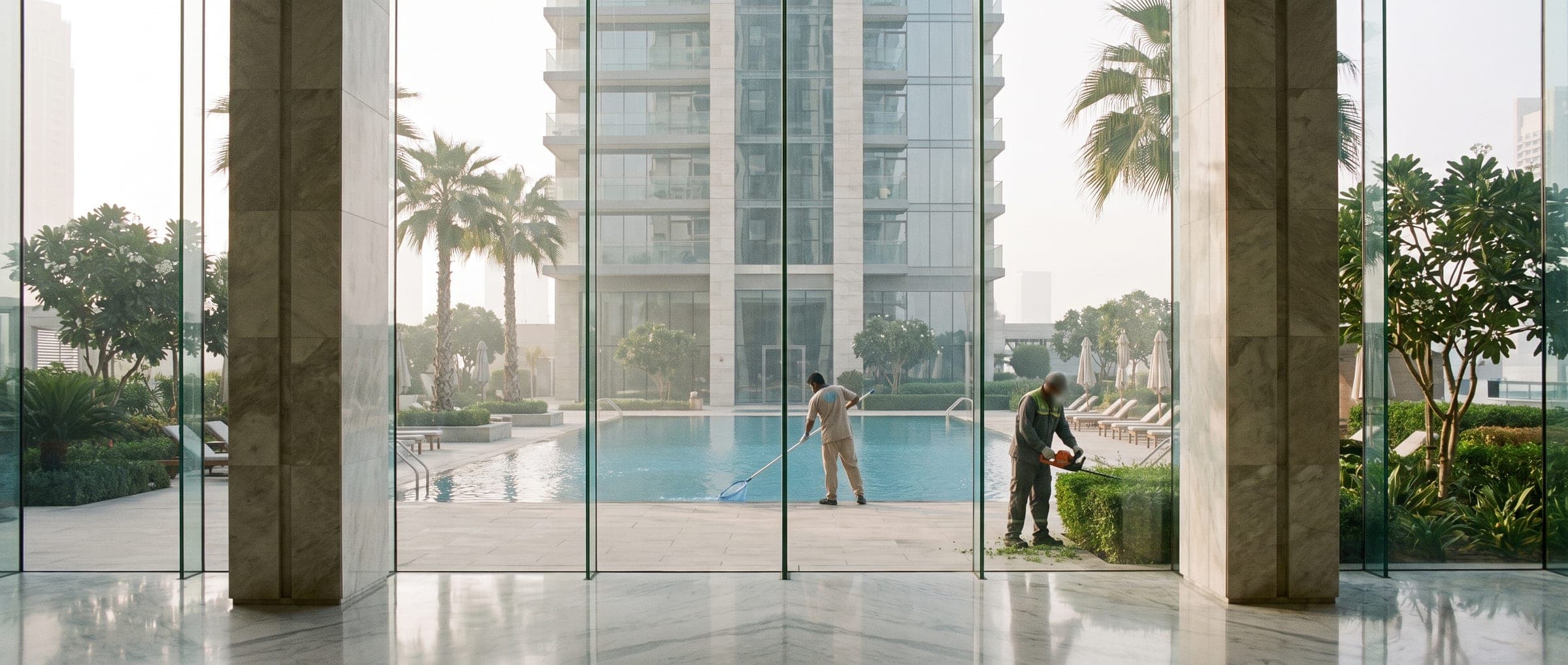
Every apartment and villa in a Dubai community pays an annual service charge to cover the shared parts of the building or estate: security, cleaning, landscaping, lifts, the pool, and a reserve fund for the day the cooling plant needs replacing. It is charged per square foot of your unit, billed by the owners' association or the developer's management company, and approved each year by RERA. None of that is secret. It is simply not on the listing.
The range is wide. A villa in an established community might pay AED 3–6 per square foot. A mid-rise apartment block, AED 12–18. An older tower with a large pool deck and a lot of glass, AED 20–28. A hotel-branded residence, more. On a 1,500-square-foot apartment the difference between the low and high end of that range is around AED 30,000 a year, which on a rent of AED 150,000 is a fifth of the gross income.
A 7% gross yield in a building charging AED 28 per foot is a 4.9% net yield before you have paid a management fee or had a week's vacancy.
Two things make service charges harder to model than they should be. The first is that district cooling, in communities that use it, is billed separately from the service charge and often to the tenant — but not always, and a capacity charge frequently stays with the owner regardless of occupancy. The second is the reserve fund: a building that has under-collected for years will eventually levy owners for the shortfall, and that levy does not appear in the headline per-foot figure.
How to read them
Ask the seller or the agent for the last two years of service charge invoices, not the projection in the brochure. The Dubai Land Department publishes a service charge index by community and by building, which is the quickest sanity check we know of. Look at the reserve fund line and ask whether the building has levied in the last three years. And find out who manages the building — the same square footage in two towers on the same street can differ by a third depending on the management company.
For off-plan, you are working from the developer's estimate, and the estimate is usually low. We compare it against handed-over towers of the same type in the same district and use the higher figure in the model. If the number the developer quotes is well below its own completed stock, treat that as information.
None of this is a reason not to buy. Well-run buildings with sensible charges hold their value better and let faster than poorly run ones with cheap charges, and a high service charge in a building that is genuinely maintained is often the better investment. The point is only that the number belongs in your model before you make an offer, not in the first invoice after you complete.